As an Amazon Associate, we earn from qualifying purchases. Some links may be affiliate links at no extra cost to you. Although our opinions are based on curated research, we haven't used these products. Articles generated with AI.

Understanding Voltmeter Use for Boat Battery Health

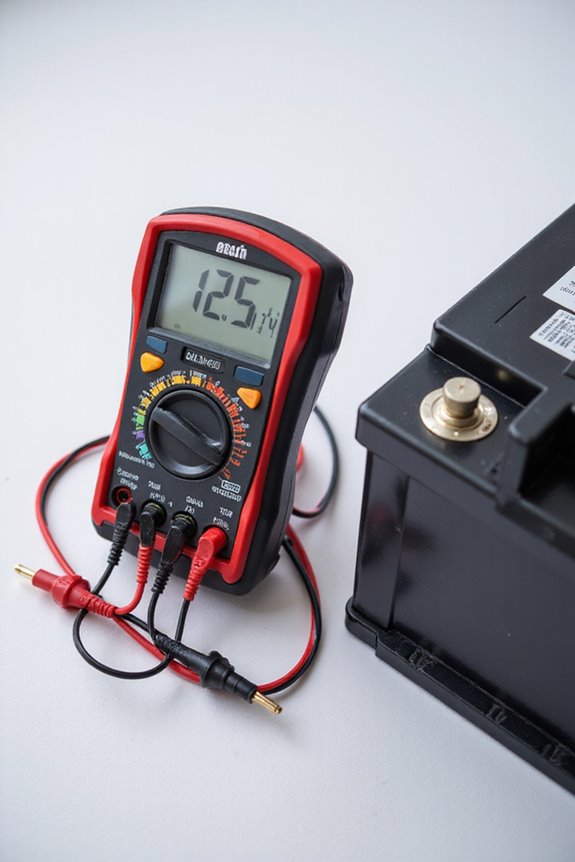
Keeping our boat’s battery in good shape is way easier when we understand how to use a voltmeter right. We pick devices with a 0-20V DC range and accurate digital displays to catch voltage dips early—because no one wants a dead battery while afloat! Before testing, we let the battery rest and clean terminals for true readings. Then, with probes on positive and negative posts, we watch for steady voltage, revealing charge health. Curious how else to keep power steady?
Key Takeaways
- Use a voltmeter with 0-20 volts DC range for accurate measurement of 12V marine batteries.
- Turn off all boat electronics and let the battery rest for at least one hour before testing voltage.
- Connect the red probe to the positive terminal and black to the negative terminal for proper reading.
- Voltage readings indicate battery charge but should be combined with load testing for full health assessment.
- Choose a durable, water-resistant digital voltmeter with a clear display for reliable marine usage.
Importance of Monitoring Boat Battery Health
You may be interested

Even though it might sound a bit technical, keeping an eye on your boat’s battery health is actually one of the smartest moves you can make before heading out to sea. Think of battery maintenance as the secret sauce to avoiding those awkward moments when your navigation or communication gear suddenly dies on you. By monitoring voltage and charge levels, we can catch early signs of trouble like temperature spikes or voltage drops. This lets us optimize the charge cycle, preventing overcharging or deep discharges that wear out the battery faster. Plus, staying on top of this means smoother engine starts and reliable power for all your gadgets. So, why risk getting stranded when a little vigilance over battery health keeps us cruising confidently and safely?
Selecting the Right Voltmeter for Marine Batteries
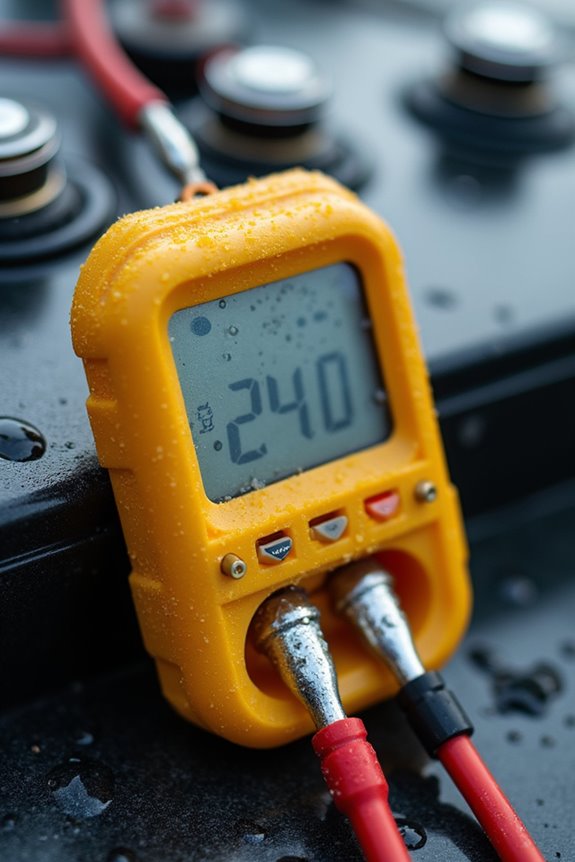
While choosing a voltmeter for your boat’s battery might seem straightforward, there’s more to it than just picking the first gadget on the shelf. We want a tool with solid voltmeter features like a wide voltage range—at least 0-20 volts DC—to comfortably handle our 12V marine batteries. Voltage accuracy is key, too; a precision within ±0.01V helps us spot subtle charge changes before problems arise. Digital displays, especially backlit ones, make reading easier in dim boat cabins. Don’t forget durability—water resistance and ruggedness are must-haves in salty, damp environments. And who wants complicated controls when we’re already juggling ropes and sails? So, we lean toward simple, reliable digital or multimeter types designed for marine use. After all, picking the right voltmeter keeps us both informed and afloat.

Monitors DC voltage on a bright, waterproof, daylight readable OLED screen. OLED screen allows viewing from sharp viewing angles and can be seen with polarized sunglasses.

PANEL & HOLE: This 12v round digital voltmeter gauge comes with a panel, two connecting wires with 10A fuse, two insulated terminals and two screws. It can be either installed separately in the mounting hole with a diameter of 29mm or fixed on the matching panel, meet your different mounting needs.

【Meet Different Needs】 The 12V round voltmeter comes with a panel and a nylon nut, which can be mounted separately on the 29mm diameter mounting hole or fixed on the matching panel, so that it could meet your different mounting needs.
Preparing a Marine Battery for Voltage Testing
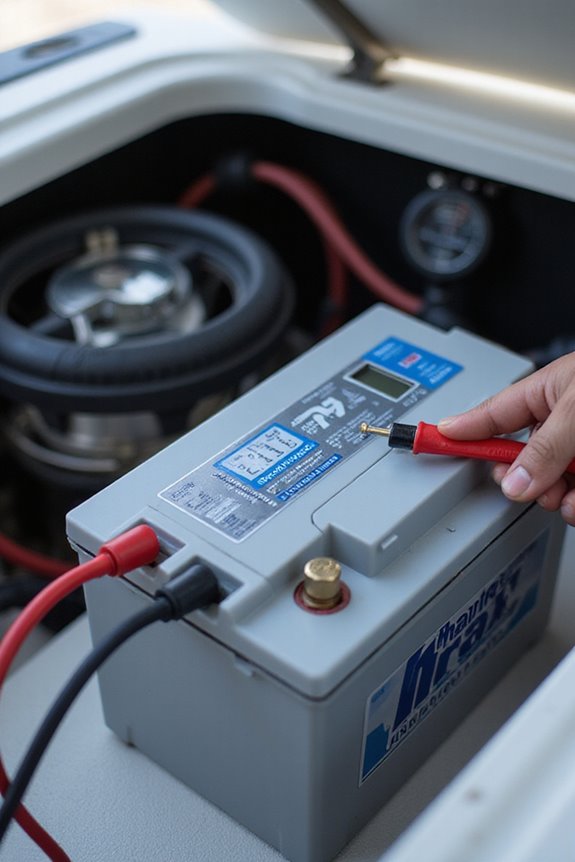
Now that we’ve picked out a voltmeter that won’t quit halfway across the ocean, it’s time to get our hands a little dirtier and prepare that marine battery for testing. First up, let’s turn off all electrical systems—no sneaky devices like automatic bilge pumps or stereos should be humming during testing. Battery maintenance starts here, ensuring the battery rests for at least an hour to stabilize voltage. We’ll locate the battery, remove its covers, and clean any corrosion with a baking soda mix—because good contact matters. Safety gear is a must. For accurate testing techniques, disconnect the negative terminal first to isolate the battery and prevent false readings. Additionally, maintaining a low self-discharge rate is crucial for ensuring reliable power during adventures. With these steps, we’re set for a clean, reliable voltage check—no surprises, just solid data.

All-In-One - The ultimate battery terminal cleaning kit provides all the tools to clean and protect your battery from battery corrosion.

CORROSION GONE! cleans leakage from all types of batteries including alkaline, nicad, nickel metal hydride and low cost zinc carbon cells.

COMPLETE KIT: Includes 1 battery terminal cleaner tool and 4 anti-corrosion fiber washers (2 red and 2 green) for comprehensive battery maintenance
Step-by-Step Guide to Measuring Battery Voltage
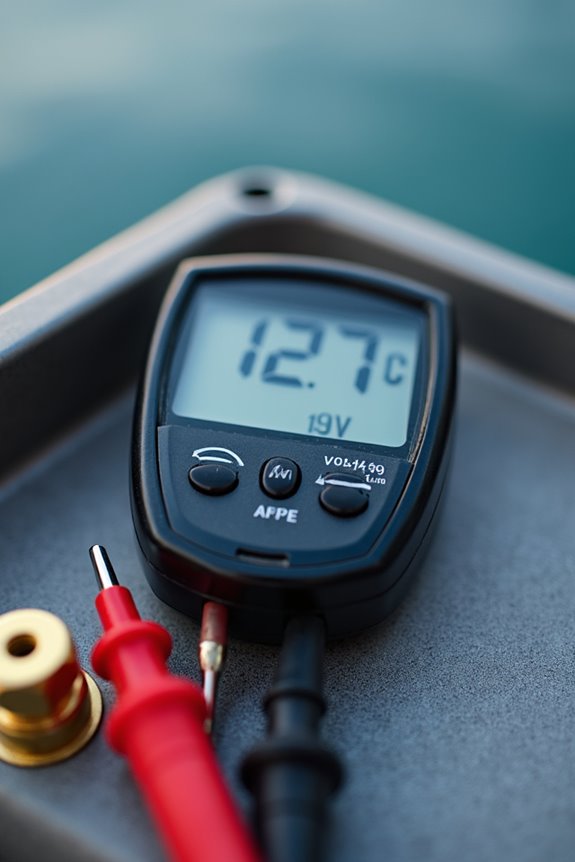
Before we plunge into the actual measuring, let’s make sure we have everything set up just right—because a voltmeter won’t do you much good if it’s not tuned for the job. First, switch off all boat electronics and let the battery rest, minimizing voltage fluctuations that could mess with our readings. Set your multimeter to the 20V DC range, grab your red probe, and connect it firmly to the battery’s positive terminal, then the black probe to the negative. Watch the meter stabilize—no sudden jumps, please! Recording steady voltage is key for proper battery maintenance. If readings keep bouncing around, double-check connections or let the battery rest longer. Additionally, understanding smart battery chargers can help maintain optimal battery health by preventing overcharging and undercharging. With careful steps, we’ll get reliable numbers to keep our boat batteries happy and our journeys smooth.

Accurately Test Full Features: Accurately measures AC/DC voltage, DC current, resistance, continuity test, diode and batteries.
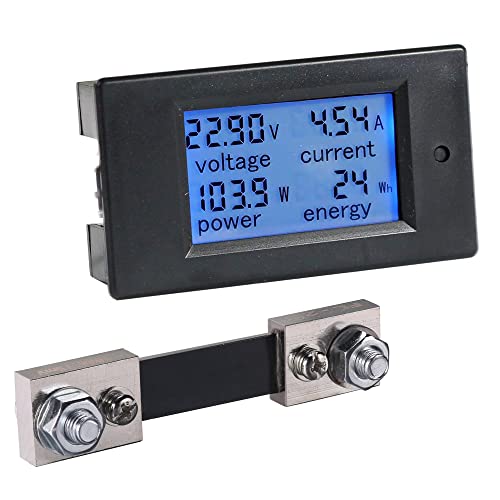
Test range: Voltage: DC 8~100V; Current: 0~100A; Power: 0~10kW; Energy: 0~9999kWh

APPLICATION --- The battery testers can be used for testing battery voltage and capacity for electric motorcycle, motorcycle,golf cart, automotive , car, marine, RV, boat, etc.
Understanding Voltage Readings and Battery Charge Levels
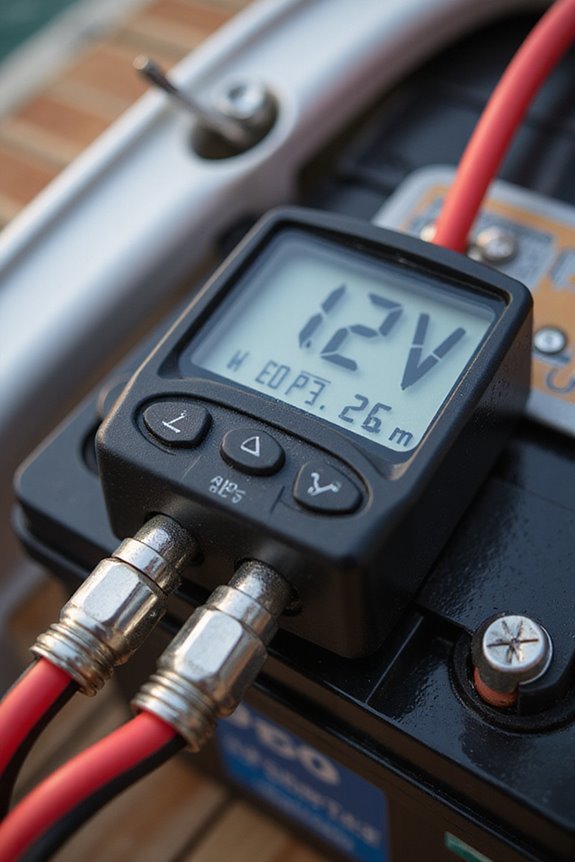
One of the first things we want to understand when checking our boat battery is what those voltage numbers actually tell us about its charge level. Seeing 12.6 to 12.8 volts usually means our lead acid or AGM battery is fully charged—nice! But if it dips below 12.4 volts, it’s a sign the battery might need some attention. Voltage fluctuations are normal, but if they’re frequent or severe, it can shorten the battery lifespan. What about lithium batteries? They run a bit higher, so 13.3 volts or more means full charge. Keeping an eye on these voltage readings helps us avoid deep discharges, which can be rough on our batteries. So, let’s stay vigilant—our boats depend on it as much as we do!
Additional Techniques for Assessing Battery Performance
While voltage readings give us a quick snapshot of battery health, they don’t tell the whole story—kind of like judging a book by its cover. To get a deeper understanding, we can try additional techniques like load testing and electrolyte measurement. Load testing, for example, lets us see how a battery performs under real-world conditions by simulating the demands of starting your engine or running onboard systems. It’s a bit like taking your battery to the gym to see if it can handle the workout. Then there’s electrolyte measurement—using a hydrometer on wet cell batteries to check the acid’s specific gravity, revealing charge states and possible issues like sulfation. These methods give us a fuller picture, helping keep our boats running smoothly without those “surprise dead battery” moments!

【Professional-Grade Accuracy for All 12V & 24V Batteries】Experience lab-grade precision with the TOPDON car battery tester and alternator tester. Employing advanced conductance technology, it delivers 99.9% accurate results for any 12V or 24V automotive battery (100-2000 CCA), including regular flooded, AGM, GEL, and deep-cycle types. This auto battery tester is your essential tool for reliable DIY battery checks, pre-road trip vehicle preparation, and professional diagnostics in home garages or auto shops, ensuring you never get a false reading.

Catch Battery Problems Early: Featured in two videos by Project Farm, a popular YouTube channel with millions of subscribers, the ANCEL BA101 helps you quickly spot battery issues before they leave you stranded. It provides easy-to-understand readings for State of Health (SOH), State of Charge (SOC), voltage, current, CCA, plus cranking and charging system tests, so you can better understand your battery and help avoid unexpected breakdowns

[Car Battery Tester] You can easily test and inspect your 12V lead-acid battery with this TOPDON car battery tester. The SOH (State of Health), SOC (State of Charge), Voltage, Current, Rating, and numerous other understandable analytical data are provided by this battery tester. It is compatible with 100-2000CCA regular flooded, AGM flat plate/spiral, EFB, and GEL for their optimum performance.
Best Practices for Maintaining Marine Battery Reliability
Although marine batteries are built tough, they still need a little TLC to stay reliable and ready for action. Let’s talk battery maintenance—keeping your battery topped off is key, so recharge before it dips below 50%. Nobody wants a sulking battery, right? Corrosion prevention is just as important; cleaning terminals with baking soda and distilled water stops that nasty buildup and keeps connections tight. Remember to apply protective covers to terminals—especially the positive one—to avoid sparks and grime. How about securing batteries? Lock ’em down firmly in trays to dodge damage from rocking waves. Regular inspections help catch trouble early; spotting leaks or swelling can save you headaches. Together, these best practices keep our marine batteries healthy and our boating adventures worry-free. Sound good?
Made in the USA

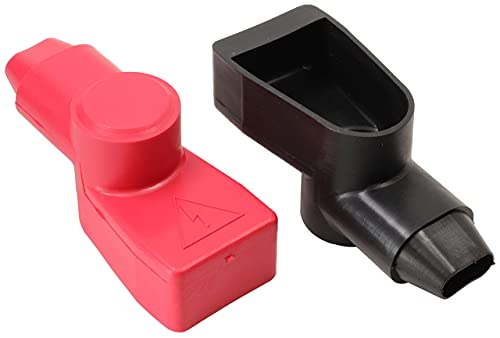
【Practical Functions】 The battery terminal protector comes in red and black colors. It is easy to distinguish the positive and negative terminals When using it. The battery cover can reduce the contact between the connector top post and the air, prevent stud wear, and have good insulation, which can reduce accidents.

【PROTECT BATTERY TERMINALS】 Car battery terminal cover can fully protect the battery terminals, with the function of splash-proof, dust-proof, oxidation-reducing, and avoiding wear and tear. Battery terminal covers are available in red and black, which can better help you to distinguish between positive and negative battery terminals.
Frequently Asked Questions
Can a Voltmeter Detect Internal Battery Damage or Only Voltage Levels?
It is understood that a voltmeter measures voltage levels but can’t directly reveal internal damage. While voltage hints at battery health, spotting internal damage needs extra checks like load testing or visual inspection for a complete picture.
How Do Temperature Variations Affect Battery Voltage Readings?
Did you know battery capacity drops by 50% at -30°C? We all face temperature effects causing voltage fluctuations, making our readings less reliable. Let’s embrace this challenge together and adjust for accurate battery health insights.
Is It Safe to Perform Voltage Tests During Stormy Weather or on a Moving Boat?
We don’t recommend voltage tests during stormy weather due to storm safety risks, nor on a moving boat amid unstable conditions. Let’s prioritize our safety and wait for calm, stationary moments to check our battery’s health accurately.
What Are Common Voltmeter Errors Specific to Marine Environments?
It is understood that voltmeter limitations in marine settings often stem from corrosion, causing distorted readings. Together, we must watch for salt buildup and moisture effects, ensuring our tools reflect true battery health despite harsh boatside conditions.
How Often Should a Voltmeter Be Calibrated for Accurate Boat Battery Testing?
We recommend sticking to a regular calibration frequency for your voltmeter, ideally quarterly, to guarantee precise testing intervals. This keeps all of us confident in accurate measurements, helping protect our boat batteries’ health together.